
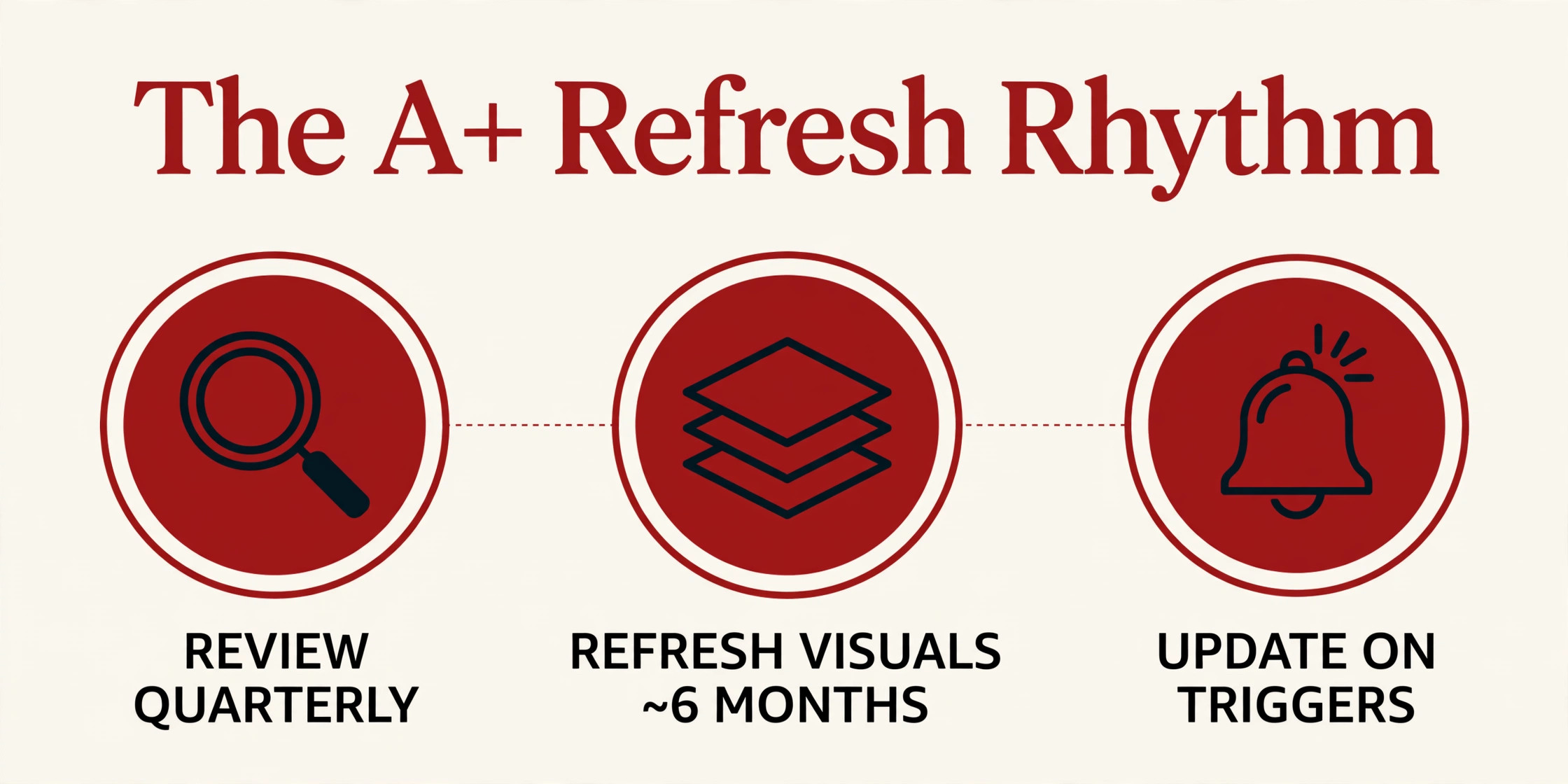
Amazon sets no fixed update interval — its own guidance says only to update content regularly so details don’t become outdated. So there’s no “refresh every 90 days or Amazon penalizes you” rule; anyone telling you that is inventing it. What I recommend to clients is a practical rhythm drawn from how experienced sellers actually work: review quarterly, refresh the visuals roughly every six months, and update immediately when one of seven triggers fires. Details below.
The rhythm I recommend
Review quarterly (look, don’t necessarily change). Every three months or so, open the A+ stack on your own product page and read it like a buyer seeing it for the first time. Check it against the current product, the current packaging, the current reviews, and the Q&A section. Most quarters, you’ll change nothing — and that’s fine. The review is the habit that catches the problems.
Refresh the visuals roughly every six months. This is the interval the listing-refresh guides I follow converge on: image stacks and A+ modules get a visual pass about twice a year, with lighter copy passes more often. “Refresh” doesn’t mean a full rebuild — it can mean swapping the hero lifestyle shot, updating seasonal framing, tightening the comparison chart, or rebuilding one module that reads dated next to competitors’.
Change one major element at a time where possible. If you rebuild the whole stack at once and conversion moves, you won’t know which change did it. Sequential changes, judged over weeks — not days — let you actually learn what’s working.
The 7 triggers: update immediately when any of these fires
Calendar rhythm aside, these are the real reasons A+ gets updated. Any one of them overrides the schedule:
- The product itself changed. New formulation, different size or count, new materials or packaging, changed accessories or instructions. Your A+ must match what ships — a mismatch is a returns and trust problem, not just stale design.
- Reviews or Q&A keep raising the same objection your current A+ doesn’t answer. That’s your buyers telling you which module to add.
- A claim, badge, comparison, or image is no longer accurate — or no longer allowed under current Amazon guidance. Rules move; “it was fine last year” is not a defense.
- A seasonal moment arrived. Q4 gifting, Prime events, your category’s season. Refresh the framing and hero imagery — but keep every product fact unchanged.
- Competitors visibly upgraded and your page now looks dated by comparison on mobile. In crowded categories, “good enough” has a shelf life.
- Conversion on the ASIN clearly fell while traffic didn’t. Content is a suspect here — alongside price, reviews, and availability. Treat it as a diagnostic prompt, not proof A+ caused the drop.
- Amazon added a module or format you now qualify for. New capabilities (say, Premium features after meeting eligibility) are worth designing around.
Three process cautions most sellers skip
Edits go back through approval. When you edit A+ Content, the new version goes through Amazon’s review flow before it replaces the live one. I won’t print a specific approval timeline as settled fact — check the status in A+ Content Manager, and never schedule a refresh at the last minute before a major sales event.
Save the current version first. Screenshot the live stack and note what you’re changing and why. Otherwise you have nothing to compare against when you judge the result weeks later.
Re-check mobile after every refresh. Most A+ is read on phones, and text baked into images is where refreshes most often break — a module that looked fine at desktop width turns its shade names or ingredient lists into unreadable micro-type on a phone.
Mini-FAQ
Will updating my A+ Content more often boost my ranking?
No rule ties update frequency to ranking. The indirect logic holds — better-converting content can help velocity — but there’s no evidence that refreshing on a tight calendar does anything by itself. Update on the rhythm and triggers above, not on a superstition.
Do small edits trigger a full re-approval?
Treat any published edit as going through Amazon’s review flow. That’s why the quarterly review (read-only) is separate from the refresh (published edits) — review often, publish deliberately.
My product hasn’t changed at all. Should I still refresh every six months?
If the product, packaging, claims, and competitive set are genuinely unchanged, a light visual pass is enough — new hero imagery, tightened copy, maybe a seasonal frame. “Fresh” signals an active brand to shoppers; it doesn’t require a redesign.
The bottom line
Quarterly review, roughly six-month visual refresh, instant updates on the seven triggers, one change at a time, judged over weeks. That’s the whole system — and it beats both extremes: the sellers who never touch their A+ again, and the ones who redesign it monthly chasing a lift that isn’t there.
If your A+ is due for its six-month pass, that’s the work I do: A+ Content design that keeps your stack current without breaking what converts. And if you’re building from scratch, my A+ image sizes guide is the spec reference to build against.