
A healthy Amazon conversion rate is usually quoted at 10–15%. But here is the honest caveat you will not hear from most guides: Amazon publishes no official conversion-rate benchmarks. Every number below is third-party or agency-reported, and the guides do not fully agree — so I will show you the bands they converge on, and then the context that actually determines where your listing should land.
The benchmark bands (third-party guide reports)
| Conversion rate | What guides call it | Source |
|---|---|---|
| Under 5% | Poor — a structural problem, not a traffic problem | Marketplace Valet, Epinium |
| 5–10% | Below average; 4–7% = room for improvement | Marketplace Valet, MyWifeQuitHerJob |
| 10–15% | Average to good — the commonly cited healthy band | Sequence Commerce, Nozzle, Epinium, Ecombrainly, AMZScout |
| 15–20% | Above average | Ecombrainly |
| 20–30% | Strong | Marketplace Valet |
| 30%+ | Excellent — mostly consumables and supplements with repeat purchase | Marketplace Valet |
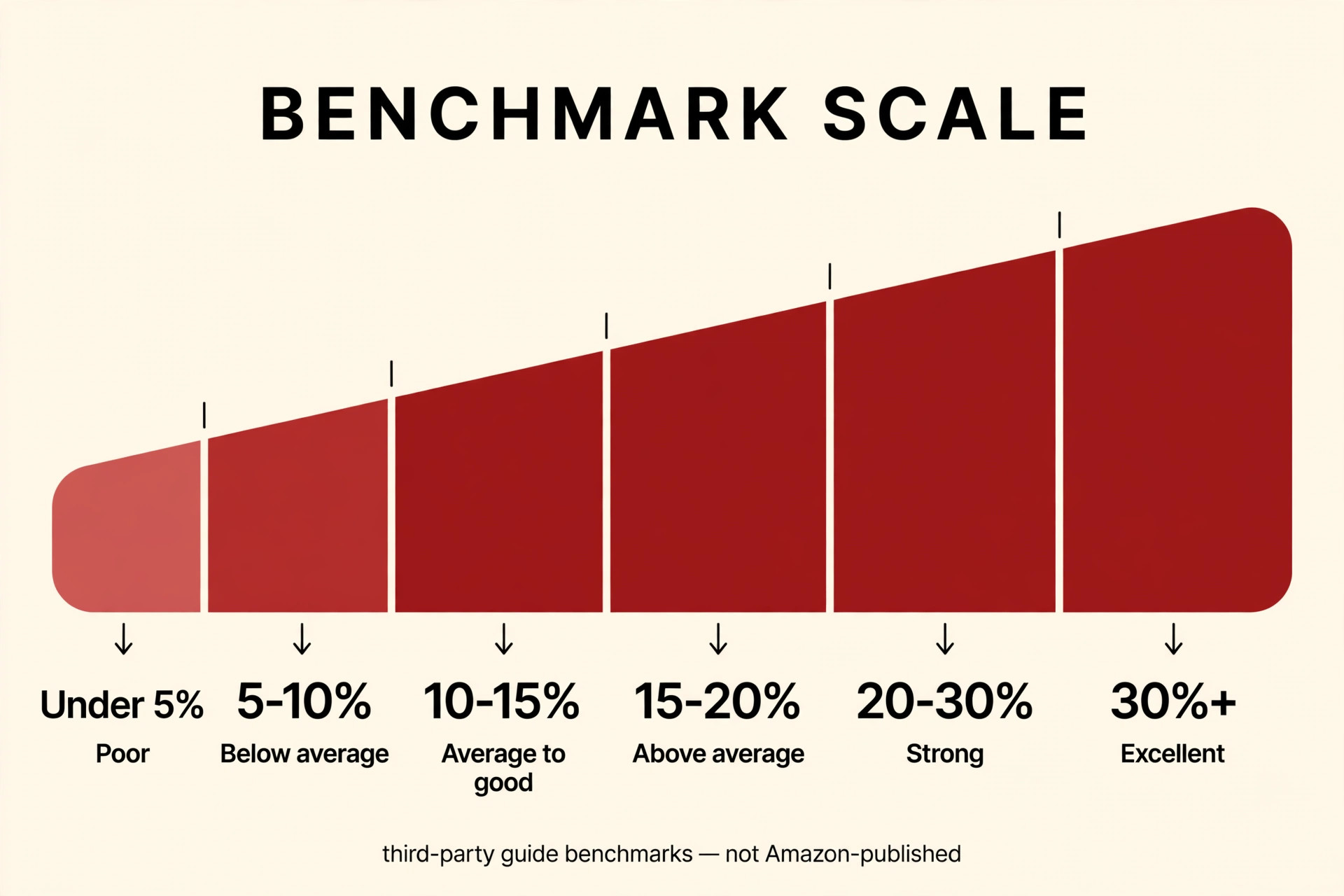
Notice the disagreements: some guides call 5–15% average, others say 10–15% or 10–20%. There is no single agreed “average Amazon conversion rate”, so do not trust anyone who quotes one number as gospel.
Two caveats that matter more than the table
1. Category and price move the band. Epinium reports that supplements and grocery can exceed 30%, while electronics and home tend to sit at 8–15%. Ecombrainly frames it by price: products under $20 should push 15–25%; items over $100 can be perfectly healthy at 5–10% because shoppers deliberate longer. My take as a designer: a $9 phone accessory and a $249 espresso machine are playing different games — do not benchmark them against each other.
2. Compare against your category, not the platform average. Epinium suggests using Brand Analytics competitor data plus Helium 10-style sales estimates to triangulate what “normal” looks like in your niche. The number that matters is how you convert versus the three listings above yours in search.
How to check yours
In Seller Central go to Business Reports > Detail Page Sales and Traffic and read “Unit Session Percentage”. The formula is simple: orders ÷ sessions × 100 (Sequence Commerce). Watch it by ASIN over at least two to four weeks — a single day’s reading means nothing.
Why the number matters beyond sales
Conversion is an output metric. Guides from Nozzle and AMZScout note that improving it lifts organic rank and lowers ad costs — Amazon rewards listings that turn sessions into orders with more visibility. That is not a guarantee of ranking, and no single metric guarantees one, but directionally, converting listings get more.
Below 5%? Start here
Under 5% is not a traffic problem — it is a closing problem. Four things I check first:
- Search-term intent. Are your clicks coming from people your product actually satisfies? Wrong-intent traffic never buys.
- Page creative completeness. A main image readable at thumbnail size, a gallery that answers objections, and A+ Content if you are Brand Registered.
- Price vs. category. A notable premium with no visible reason is a conversion tax on every click.
- Reviews. New listings convert roughly 40–60% below the category average until 15–25 reviews land (Ecombrainly, guide-reported) — a new ASIN is not broken, it is young.
The fix-by-fix version of all of this lives in my companion post on how to improve your Amazon conversion rate. I also wrote the full traffic-without-sales diagnosis, plus how listing images affect organic ranking, whether A+ Content helps rankings, and my listing image requirements checklist.
FAQ
Do cheaper products really convert higher?
Yes — Ecombrainly’s price bands show it plainly: under-$20 products should hit 15–25%, while $100+ products can be healthy at 5–10%. Price is the biggest honest predictor of which band you sit in.
Should a new product expect a lower conversion rate?
Yes. Guide-reported: new listings convert roughly 40–60% below the category average until 15–25 reviews land. Compare a new ASIN against other new ASINs, not established competitors.
Should I fix traffic or conversion first?
Conversion — always. Fixing the rate at which clicks become orders lifts everything downstream: the same traffic earns more, and Amazon rewards converting listings with visibility (Nozzle, AMZScout, guide-reported).
If your listing is converting below its band and you suspect the page — not the product — is the problem, that is exactly what I do. Contact me and I will audit your listing creative.

Azam Khan Tarakai
Founder, Lystiq Creative — Amazon Listing Image & A+ Content Designer
I design Amazon listing images, A+ Content, Brand Stories and Storefronts that turn browsers into buyers — built on my C.A.S.H. Creative Framework™.