No — not directly, and Amazon has never said otherwise. Amazon has never confirmed A+ Content as a ranking factor. What A+ does, when it’s good, is lift conversion: more of your existing traffic buys. And conversion feeds sales velocity, which is one of the heaviest inputs into organic rank. So the honest answer is a chain, not a switch: A+ improves conversion, conversion improves velocity, velocity improves rank. The ranking gain is real but indirect — and if anyone sells you A+ as an SEO product, that’s a red flag.
I get asked this constantly by sellers deciding whether A+ is worth the production cost. Let me lay out the mechanism honestly, because the misunderstanding costs people money.
What Amazon actually says (and doesn’t say)
Amazon’s public material about A+ talks about sales lift and conversion — never search rank. The figures Amazon publishes are conversion and sales claims, attributed to Amazon’s own internal data (which it publishes without methodology): Basic A+ can increase sales by up to 8%, Premium A+ by up to 20%. Those are conversion figures, not ranking figures, and not guarantees — my Premium vs Basic guide unpacks them with full attribution.
What Amazon has never published: any statement that A+ is a direct ranking factor. No honest secondary guide I’ve read claims otherwise either. The consensus across the ranking guides I checked is consistent: A+ doesn’t directly move rank through any indexing mechanism.
The indirect chain that actually works
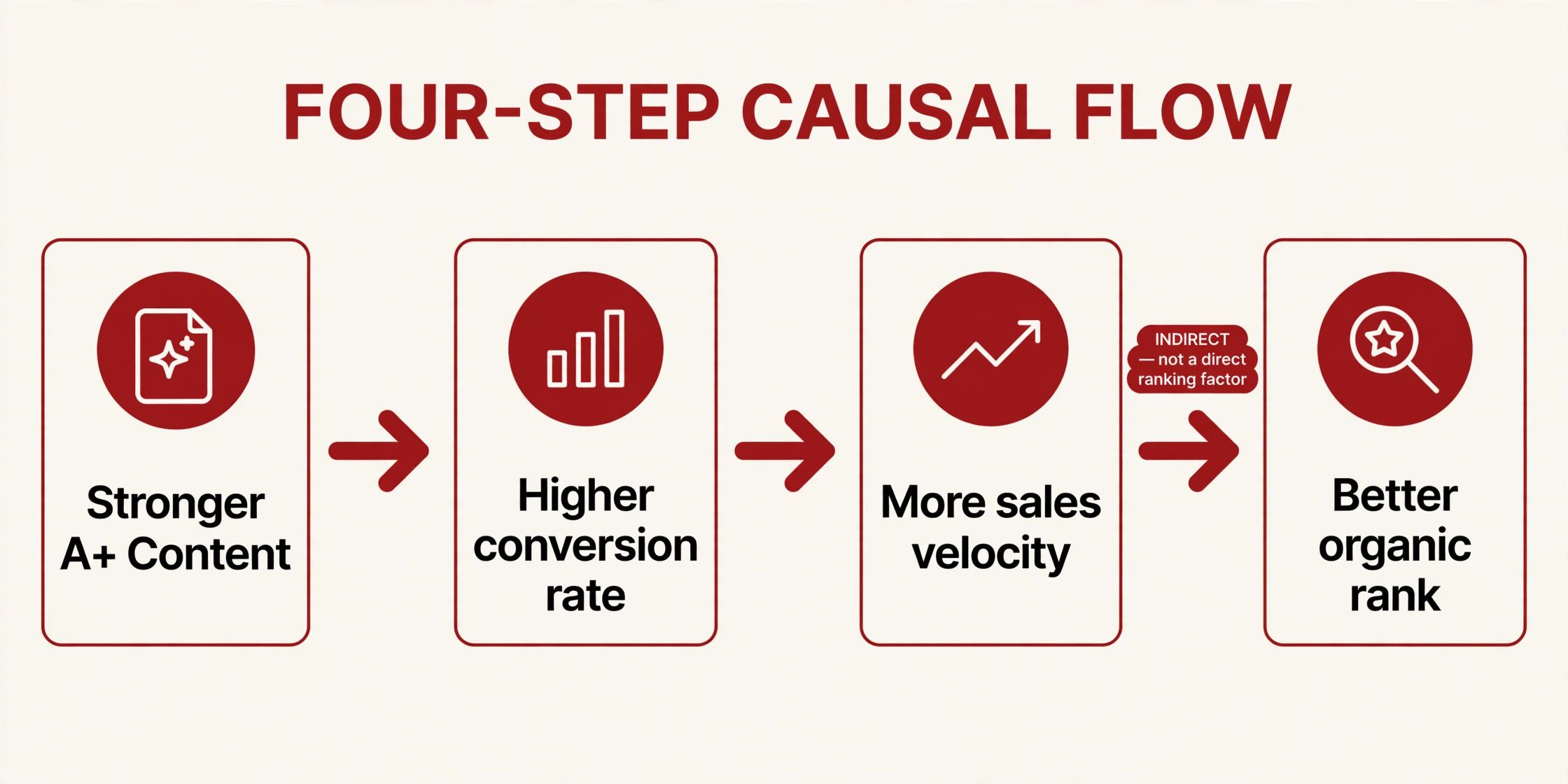
Here’s the mechanism, step by step:
- Conversion rate feeds ranking. Amazon’s own algorithm guidance treats conversion rate as a core performance signal. Strong conversion tells Amazon the listing communicates value effectively — and Amazon rewards that with organic visibility.
- A+ is a conversion lever. Richer modules — comparison charts, feature-with-proof, lifestyle in-use, ritual sequences — answer objections and reduce uncertainty. That’s the mechanism behind Amazon’s 8%/20% conversion claims. Better A+ doesn’t change your traffic; it changes what your traffic does.
- Sales velocity moves rank. Higher conversion on steady traffic means more orders. Sustained sales velocity is the heaviest organic-ranking input — it’s Amazon’s clearest signal that shoppers want this product for this search.
- A+ text is not keyword-indexed. One more myth to bury: A+ module text doesn’t get indexed for search keywords the way your title and bullets do. If someone told you to “stuff keywords into A+ alt text,” that advice is dead. My Rank #1 article covers the real keyword work — it lives in your title, bullets, and backend terms, not your modules.
When A+ can’t move the needle
A+ owns only the conversion side of the ranking formula. Traffic + conversion is the equation, and if your problem is on the traffic side, A+ won’t fix it:
- No traffic: that’s a CTR problem — main image and title. Fix those first.
- Price or review mismatch: if you’re priced 20% above the buy-box competition with 40 reviews, no module stack closes that gap.
- Stock gaps: going in and out of stock breaks velocity regardless of content.
- Weak relevance: if the listing targets the wrong keywords, better content converts the wrong audience slightly better.
Practical sequencing, in my experience: fix the main image and bullets first (CTR + relevance), then add A+ for conversion, then measure conversion rate in Seller Central for 2–4 weeks before judging it — not days. Listing changes get judged over weeks.
Mini-FAQ
Should I add A+ hoping for a page-1 jump?
Expect a conversion improvement, not a rank jump. If your traffic is healthy and your conversion rises, the rank may follow through velocity — but buy A+ for the conversion, not the rank.
Does Premium A+ rank better than Basic A+?
No — neither is a direct ranking factor. Premium’s edge is bigger conversion upside (Amazon’s up-to-20% claim vs up to 8% for Basic), which means a bigger potential velocity effect. Same mechanism, larger lever.
Can good A+ hurt my ranking?
Not directly — but stale or inaccurate A+ can hurt conversion (mismatched product facts, outdated packaging), and falling conversion drags velocity down. That’s an argument for keeping A+ current, not for skipping it.
The bottom line
A+ Content doesn’t rank you higher. It sells more of the traffic you already have — and that can rank you higher.
If you’re ready to build A+ that converts, that’s the work I do: A+ Content design built around the conversion levers above. And if ranking is the actual goal, start with the full-funnel playbook in my Rank #1 article — A+ is one chapter of that story, not the whole book.