
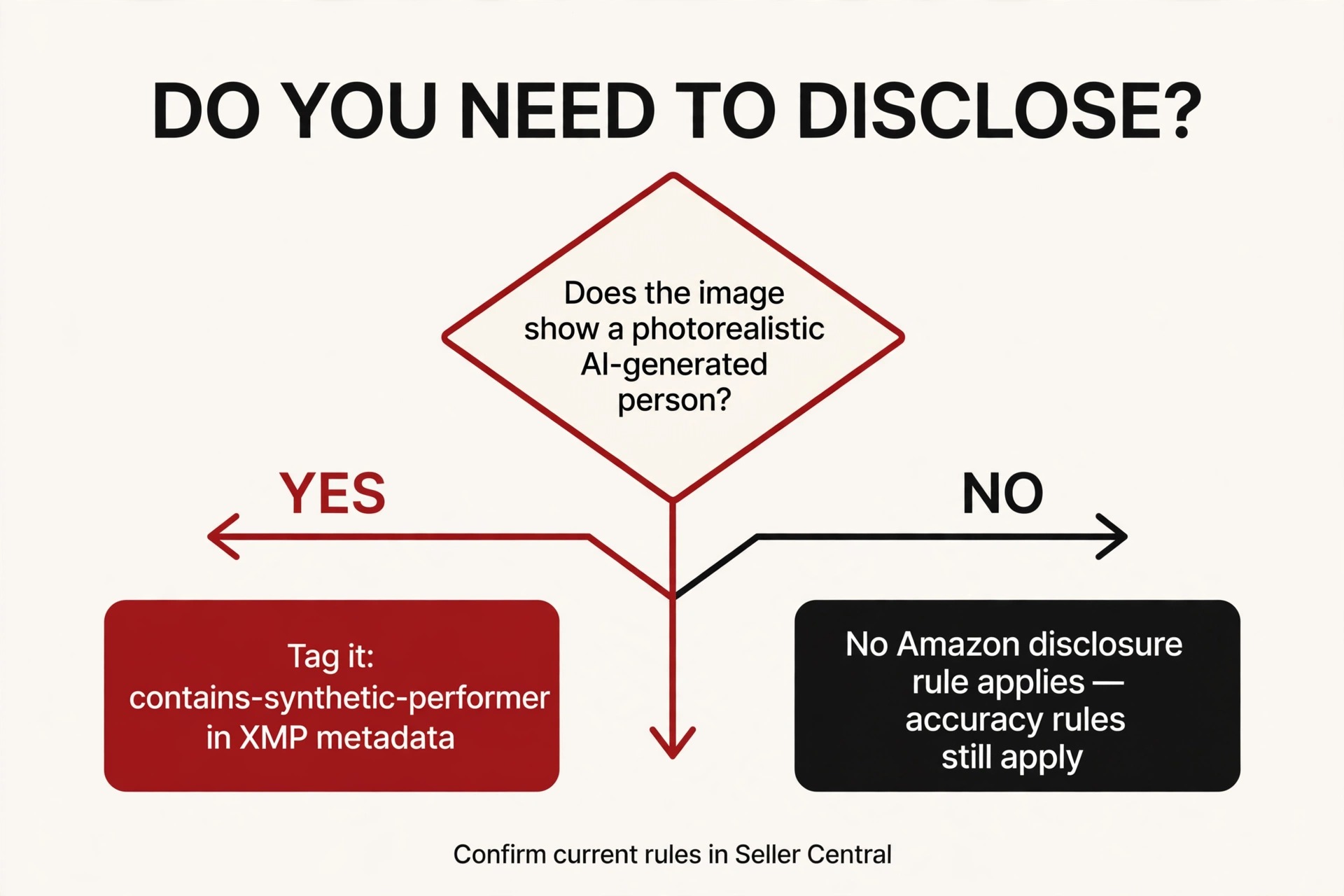
No — Amazon does not require a general disclosure for AI-generated product images. There is exactly one documented disclosure-adjacent requirement: a metadata tag (contains-synthetic-performer) for images and A+ videos containing photorealistic AI-generated people, in effect since July 27, 2026. If your AI images show only the product, backgrounds, and scenes with no people, no Amazon disclosure rule applies to them as of October 2026.
This is the natural follow-up to my post on whether the main image can be AI-generated. That post covered the policy; this one narrows to the single rule sellers keep asking about.
The one rule that actually exists
In August 2026, CNBC reviewed Amazon’s actual seller notice (coverage carried by eWeek, TipRanks, Marketing EndeavorEdge): Amazon told sellers that “recent legislation requires disclosure when images or videos in advertisements contain photorealistic AI-generated people.” The mechanism is a metadata keyword — contains-synthetic-performer — added to the XMP dc:subject field of qualifying product images and A+ content (videos, enhanced graphics) before upload, using an IPTC-compatible editor. The seller notice went out July 22, 2026 and took effect July 27 (DAM Law Firm, 2026).
Two details sellers get wrong: first, Amazon said it will use the tag to display a disclosure on listings “where applicable” — but has not disclosed the criteria for when the label actually appears, so don’t describe a shopper badge as live (Marketing EndeavorEdge; eMarketer). Second, the tag is metadata, not a visible label you design — Amazon decides.
What does NOT need disclosure
This is the part that surprises sellers, because the trade press has been loud. The scope is deliberately narrow (sentrykit.com, 2026; amazonsellers.attorney, 2026):
- AI-generated backgrounds, props, or lifestyle scenes without a human figure — no tag needed. (sentrykit’s FAQ answers this one verbatim: “Do I need to tag AI-generated background or lifestyle scenes without people in them?” — No.)
- AI product renders without people — no tag needed. Accuracy rules still apply (see today’s full policy map), but disclosure isn’t one of them.
- Real photos of real models, even AI-retouched — exempt. AI relighting, background replacement, and retouching don’t create a synthetic performer.
- TV/film/game characters or clearly fictional characters — excluded.
- AI-generated copy on infographics — no disclosure rule; claim accuracy is the requirement, not labeling.
The tag applies, in amazonsellers.attorney’s framing, “only to people who never existed.”
The honest conflict: broad vs. narrow
You’ll see trade press (asdonline.com, Aug 2026) state broadly that “Amazon now requires third-party sellers to disclose when product photos are created using artificial intelligence” — and advise retailers to “label synthetic images.” That reading collides with the documented mechanism: CNBC’s review of Amazon’s actual notice and all three seller-facing legal guides describe tagging only for photorealistic AI people, with explicit exemptions for non-people AI content.
I present both honestly because both are “true” in different frames: the broad reading reflects where regulators are moving (state laws are fragmenting — New York’s GBL §396-b took effect June 2026 with $1,000/$5,000 civil penalties; California’s AI Transparency Act is operative since August 2), while the narrow reading is what Amazon actually documented and operationalized. My bottom line: as of October 2026, no documented Amazon rule requires disclosure of AI-generated product-only images. “Check Seller Central’s current guidance” isn’t boilerplate here — it’s the actual answer, because this landscape is moving.
One more layer worth knowing (sentrykit, 2026, citing FTC endorsement guidance): under federal guidance, an undisclosed AI-generated endorser is treated as inherently deceptive, and disclosures must be clear and conspicuous — not buried in metadata. That’s FTC context, not an Amazon rule, but it’s the reason the people-scope exists.
How the tag works in practice
One paragraph, then a pointer: audit your catalog for photorealistic AI people (the clothing category is the trap — an AI “model” wearing your garment qualifies), confirm the person is entirely AI-generated and not a retouched real photo, add the contains-synthetic-performer keyword via an IPTC-compatible editor, and re-upload. Document what you changed. No self-audit tool exists — the review is manual. The full tagging walkthrough is in my A+ mistakes post; the account holder is liable for every asset even if an agency or freelancer made it (amazonsellers.attorney).
The 4-step disclosure audit
- Find the AI people. Scan every image and A+ video across your catalog for human figures you didn’t photograph.
- Confirm photorealistic + entirely AI. Retouched real photos are exempt; fictional characters are excluded. Only never-existed people qualify.
- Tag and re-upload qualifying assets with the metadata keyword before they go live.
- Document it. Keep a simple record of which assets were tagged and when — account-health disputes are won with records.
If you don’t use AI-generated people at all, your audit takes five minutes and your answer is: nothing to disclose.
Mini-FAQ
Does the rule apply outside the US?
Yes — Amazon applied the requirement globally across all its stores (sentrykit, 2026), even though it was triggered by US state legislation.
What about AI-retouched photos of real models?
Exempt. Relighting, background swaps, and retouching a real person’s photo don’t create a synthetic performer.
Will shoppers see a label on my listing?
Unknown. Amazon says “where applicable” and hasn’t disclosed the criteria. Don’t promise — or fear — a badge you can’t verify.
Need this handled by someone who tracks these rules for a living? I do listing creative for Amazon sellers — and I audit AI assets as part of the job.

Azam Khan Tarakai
Founder, Lystiq Creative — Amazon Listing Image & A+ Content Designer
I design Amazon listing images, A+ Content, Brand Stories and Storefronts that turn browsers into buyers — built on my C.A.S.H. Creative Framework™.
2 Responses