
Key Takeaways
- ✓ A Brand Story sells the brand while A+ Content sells the product — a Brand Story that re-lists features and duplicates your A+ modules is the most common failure in this space.
- ✓ Working Brand Stories run one of six narrative patterns — origin, craft and process, values and mission, product lineup tour, lifestyle world, or founder story — and your strongest pattern leads.
- ✓ Follow the four-card rule: one background, one idea per card, headlines of five words or fewer, and a final card that points the shopper somewhere.
- ✓ The Brand Story’s jobs are reassurance, differentiation, and cross-sell context for a shopper already on your page — it isn’t indexed for search, so it won’t move your ranking.
- ✓ Build it once and roll it out across your ASINs: the Brand Story requires Brand Registry, Amazon reviews it before it goes live, and it’s the cheapest premium surface on your product page to maintain.
Most Amazon Brand Stories fail for the same reason: they read like an About Us page that got uploaded by accident. The good ones don’t — they run a narrative pattern, the same way a good listing image runs a concept. This post shows you the six patterns that work, what each one is for, and how to tell which one your brand should run. All of the visuals are fresh illustrative mocks I made for this post — not client work, not real results. Every panel uses an invented coffee brand called “EMBERFOLD” that doesn’t exist, so you can study the pattern without mapping anything onto a real brand. No metrics are printed anywhere in this article: an illustrative mock can’t generate evidence, and I’d rather give you honest diagnosis than borrowed numbers.
What a Brand Story actually is (in 60 seconds)
The Brand Story is a swipeable carousel on your product detail page, in the section Amazon labels “From the brand.” If you also have A+ Content, the Brand Story typically sits right around it — the guides that document this feature place it just above the A+ modules, and it’s built inside the same A+ Content Manager (Seller Central: Advertising → A+ Content Manager), with roughly 19 cards available, per those guides.
Two eligibility facts, both established and uncontroversial: you must be enrolled in Amazon Brand Registry (which needs a registered or pending trademark), and Amazon reviews your Brand Story before it goes live, checking quality and formatting rules. One practical fact that makes this module unusually cheap to maintain: you can build one Brand Story and roll it out across your ASINs, rather than designing a new one per product. Module and card details shift over time — if anything here contradicts what you see in Seller Central today, the current requirements win.
So the division of labor: A+ Content sells the product, the Brand Story sells the brand — and confusing the two produces the most common failure in this space, a Brand Story that re-lists product features and duplicates the A+ modules below it.
Why it matters (the honest version)
Shoppers on a product detail page are in a transactional mindset — they’re deciding whether to buy this item, not browsing your catalog. That reframes what “success” looks like: your Brand Story’s job is not to drive clicks to your Brand Store (though it can include store links and product cards). Its jobs are:
- Reassurance. A real brand with a face, a place, and a point of view looks legitimate — which matters most for premium or unfamiliar brands, where the shopper is spending real money on a name they just met.
- Differentiation. When your product looks like five other listings at the same price, “who we are and why we exist” is a moat no competitor can copy in a weekend.
- Cross-sell context. A “shop the lineup” card puts your other products in front of a buyer who is already warm — a teaser, not a funnel.
Notice what isn’t on that list: keyword ranking. A+ and Brand Story text isn’t indexed for search, so this module won’t move your position. It works on the shopper who’s already on the page — and that’s the shopper who matters.
The six narrative patterns
Every Brand Story I’ve seen that works runs one of these six patterns — or stacks two or three. The pattern is the story shape; your brand’s details fill it in. Each one is illustrated with the fictional EMBERFOLD coffee brand so you can see the pattern independent of any real company.

Pattern 1: The origin story
The shape: where the brand started, in a scene the shopper can picture. A kitchen in Portland. A garage that smelled like pine.
Why it works: origin is the fastest trust shortcut in branding — it answers “are you real?” before the shopper has formed the question. It also anchors every later card; “small-batch” and “family-owned” read as consistent rather than claimed.
When to run it: lead with origin when your brand is young, unfamiliar, or premium — the cases where legitimacy is the first doubt. If your brand is already well-known, origin is garnish, not the lead.
The mock: EMBERFOLD’s first card shows a warm roastery illustration with the headline “It Started in a Garage in 2016.” One sentence, one place, one year. The temptation is to write a memoir; the pattern is a scene.
Pattern 2: Craft and process
The shape: how the product gets made — the steps, the materials, the hands. Roast curves. Stitching. Pour-over of resin, fold of fabric, tempering of steel.
Why it works: process is visible quality. Shoppers can’t touch your product, so showing the making is the closest thing to proof — and the pattern that most directly justifies a price premium.
When to run it: craft-heavy products (food, skincare, handmade goods, gear) and anything priced above the category median. If your process is genuinely distinctive, this is your lead pattern.
The mock: the second card shows the roaster with the headline “Roasted in Small Batches” — one sentence about batch size, no temperature curves, no lecture. Craft cards work when they show one detail well, not when they explain the whole factory.
Pattern 3: Values and mission
The shape: what the brand stands for, stated as something it does, not something it believes. Sourcing commitments, certifications, giving programs, labor practices.
Why it works: values are the only pattern aimed at shoppers who already trust your product — they convert a satisfied buyer into a loyal one. They also filter: the right values card attracts your people and politely repels everyone else.
When to run it: certifications your buyers already recognize (organic, fair trade, recycled materials), or a mission that’s genuinely operational. My warning: a values card that only claims things (“We care about quality!”) reads as filler. Values are shown, not declared.
The mock: the third card carries the headline “What We Stand For” with a sourcing commitment — one specific claim, no parade of adjectives.
Pattern 4: The product lineup tour
The shape: your other products as a system — the range, the refills, the accessories — so the shopper sees a brand with a shelf, not a one-hit seller.
Why it works: this is the only pattern allowed to be commercial, because the shopper expects it here. It answers “is there a bigger size / a bundle / the accessory I need?” — questions that, unanswered, leak to competitors.
When to run it: if you have more than one product, include this card. Always. Lowest-effort card to make, and the only one with a direct cross-sell job.
Pattern 5: The lifestyle world
The shape: the world your brand inhabits — the morning kitchen, the trailhead, the workbench at dusk. No product close-ups; the product appears the way it would in the shopper’s life.
Why it works: lifestyle is aspiration compressed into one frame. For categories where the outcome is the purchase (fitness, home, outdoors), a lifestyle card puts the shopper in the scene.
When to run it: emotional or identity-driven categories — and here’s the discipline: lifestyle cards earn their slot only when the scene is specific. “Happy family outdoors” is stock; “the camper van kitchen at 6 AM” is a world.
Pattern 6: The founder story
The shape: the person behind the brand — a photo, a quote, a two-sentence bio. The simplest pattern and, in my view, the most underused.
Why it works: people buy from people, especially on a marketplace where every listing is otherwise a SKU. A founder card humanizes the whole story retroactively — after seeing the face, the shopper re-reads the origin card as someone’s story. A face is the one element on a PDP that can’t be commoditized.
When to run it: founder-led brands, family businesses, expert-led categories (a formulator for skincare, a chef for cookware). The card is a face plus a quote, not a LinkedIn profile. One honesty note: if you’re white-labeling generic products with no real founder involvement, this pattern will read as fiction. Skip it.
Anatomy of a strong module (the four-card rule)
Good Brand Stories share an anatomy regardless of which patterns they run. The EMBERFOLD mock shows it: one background banner, four cards, every card with exactly one job.
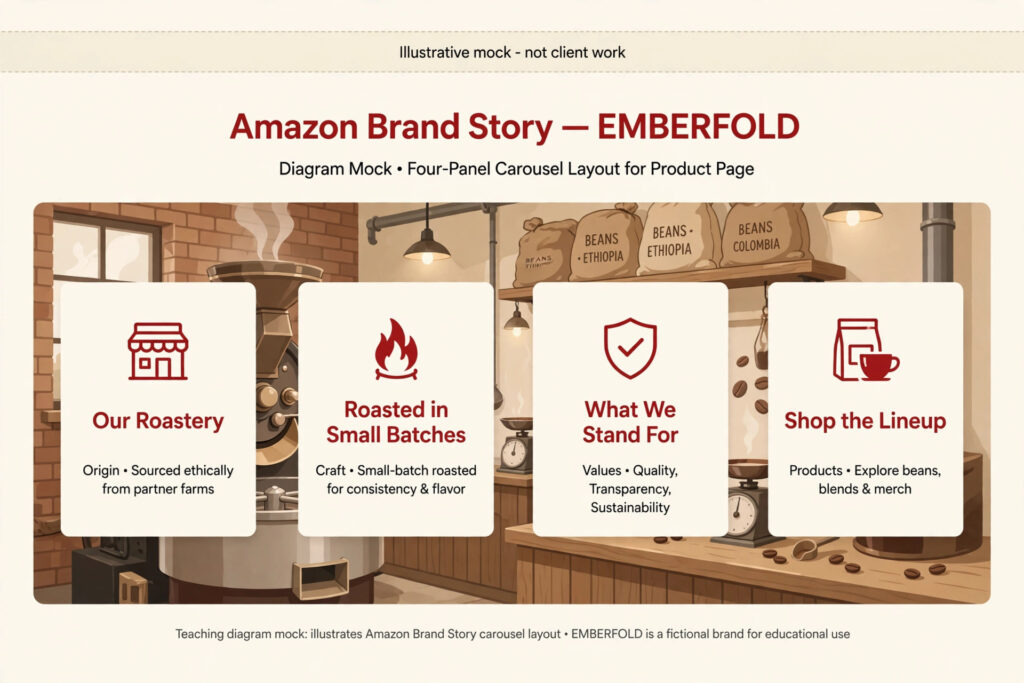
Card 1 is the hook. The carousel’s first card decides whether the shopper swipes at all. Lead with your strongest pattern — origin for unfamiliar brands, craft for premium ones, the founder for personality brands. Never lead with the lineup tour; nobody swipes for a catalog.
One idea per card. A card that says three things says nothing — each gets one headline, one short sentence, one visual. If a card needs a second sentence, it needs a second card.
Copy stays short. Headlines of five words or fewer; body of one or two sentences; no paragraphs. The module must show something the bullets can’t.
Lifestyle beats stock. Every card’s image should be something a stock library couldn’t produce: your roastery, your founder, your process, your packaging. Generic imagery in a Brand Story is a contradiction — the module exists to prove you’re a real brand, and stock photos prove the opposite.
Close with a direction. The last card points somewhere: the lineup, the store, the flagship product. Tell them where to go next.
Common mistakes (the six I see most)
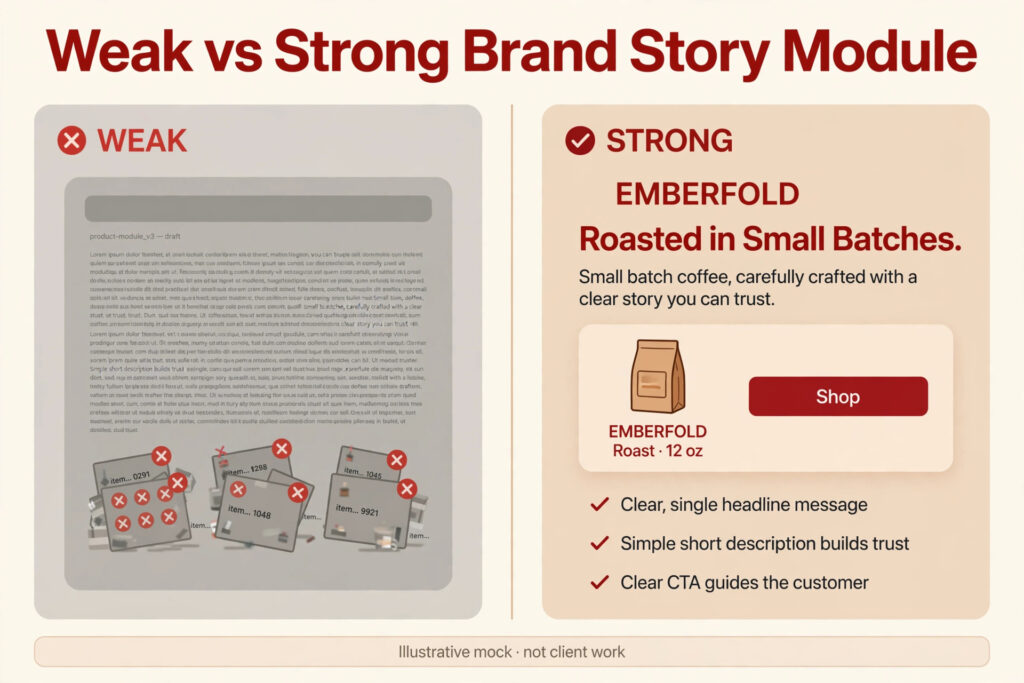
The About-Us upload. One card with a paragraph of company history. Brand Stories are carousels, not documents — if yours is one dense card, you’ve uploaded a PDF with extra steps.
The A+ duplicate. Product features, spec tables, benefit icons belong in A+ Content. A Brand Story that re-lists the product’s features wastes the only brand-level surface on the page. Test: if the card could sit in your A+ modules without looking odd, it’s in the wrong place.
Claim-heavy copy. “Premium quality,” “best-in-class,” “we care” — claims without evidence. In a module whose whole point is trust, unproven superlatives do active damage. Say one specific thing (a certification, a batch size, a year) or say nothing.
Burying the hook. Founder card or origin scene at card seven of nine — nobody gets there. Your best card goes first; the lineup goes last.
The bland mandatory background. The background banner sets the tone for every card — a flat color or stock texture here flattens everything on top of it. Spend design effort here, not save it.
Designing desktop-first. Most shoppers see this module on a phone, as a thumb-swipeable strip. Cards must read at phone size: big type, one visual, no fine print. If your designer shows mockups at desktop scale only, ask for the phone version before approving.
Brand Story vs. A+ Content (the clean divide)
| Brand Story | A+ Content | |
|---|---|---|
| Subject | The brand — who you are | The product — what it does |
| Scope | One story, rolled out across your ASINs | Built per product (or per content set) |
| Typical position | “From the brand” section, typically just above A+ Content | Below, in the product-description area |
| Eligibility | Brand Registry, Amazon review before live | Brand Registry, Amazon review before live |
| SEO effect | None — content isn’t indexed for search | None — same |
The takeaway for your workload: the Brand Story is designed once and reused; A+ Content is the per-product work. If you’re budgeting design effort, that’s the split — and it’s why the Brand Story is the cheapest premium surface on your PDP to maintain. The visual discipline is the same one I teach in my infographic guide — one idea per panel, five-word headlines, show-don’t-claim — and if you’d rather have it done for you, my Brand Story design service and A+ Content design service pages lay out what’s included.
A 5-minute Brand Story self-audit
- The one-pattern test: can you name which pattern each card runs? A card that runs none of them is decoration — cut it.
- The duplicate test: could any card sit in your A+ Content without looking odd? Move it out.
- The hook test: is your strongest card first? Swipe your own module on your phone and count how many cards you’d actually open.
- The claim test: for every adjective you can’t prove with a fact on the same card, rewrite the card around the fact.
- The stock test: could a competitor in your category use the same imagery? If yes, it’s not telling your story.
FAQ
Do I need Brand Registry to create a Brand Story?
Yes. It lives inside the A+ Content Manager and is gated like A+ Content: Brand Registry enrollment, which requires a registered or pending trademark. Without it, the option doesn’t appear. Amazon also reviews your Brand Story for quality and formatting before it goes live, so build to the rules, not around them.
How do I actually build one?
In Seller Central, go to Advertising → A+ Content Manager and look for the Brand Story option: a background plus cards (brand intro, values, product showcases, store links), submitted for Amazon’s review. Guides describe roughly 19 cards and four module types; those details shift, so check Seller Central’s current requirements against whatever guide you read.
Can I use one Brand Story across all my products?
Yes — the feature’s best property. Build the story once and roll it out across your ASINs instead of designing per product. Some sellers tailor stories for specific lines or categories, but the base case is one brand, one story, everywhere.
Does a Brand Story affect my search ranking?
Not directly. A+ and Brand Story content isn’t indexed for Amazon search keywords — ranking comes from titles, search terms, and the usual listing factors. The Brand Story works on the shopper who’s already on your page: reassurance, differentiation, a nudge toward your other products.
Do I still need one if I already have A+ Content?
Yes, because they do different jobs. A+ sells the product; the Brand Story sells the brand — the only place on the page dedicated to that. If your brand matters to your price point, the story is the missing half.
What does a Brand Story cost to design?
Publishing is widely reported as free for brand-registered sellers — the cost is design and copywriting, whether that’s your time, a freelancer, or an agency. I publish no prices here; what drives a quote is module count, revisions, and whether copywriting is included.
How long does approval take?
Amazon reviews Brand Stories before they go live, checking quality and formatting. Timelines vary by account and queue — submit, then check the A+ Content Manager status rather than guessing. Build it compliant the first time (no prohibited claims, clean formatting) and the review is just a waiting game.
If your brand has a story worth telling but your module reads like an About-Us upload, get in touch — I’ll tell you which pattern your brand should lead with and whether your current cards are running it.

Azam Khan Tarakai
Founder, Lystiq Creative — Amazon Listing Image & A+ Content Designer
I design Amazon listing images, A+ Content, Brand Stories and Storefronts that turn browsers into buyers — built on my C.A.S.H. Creative Framework™.
3 Responses