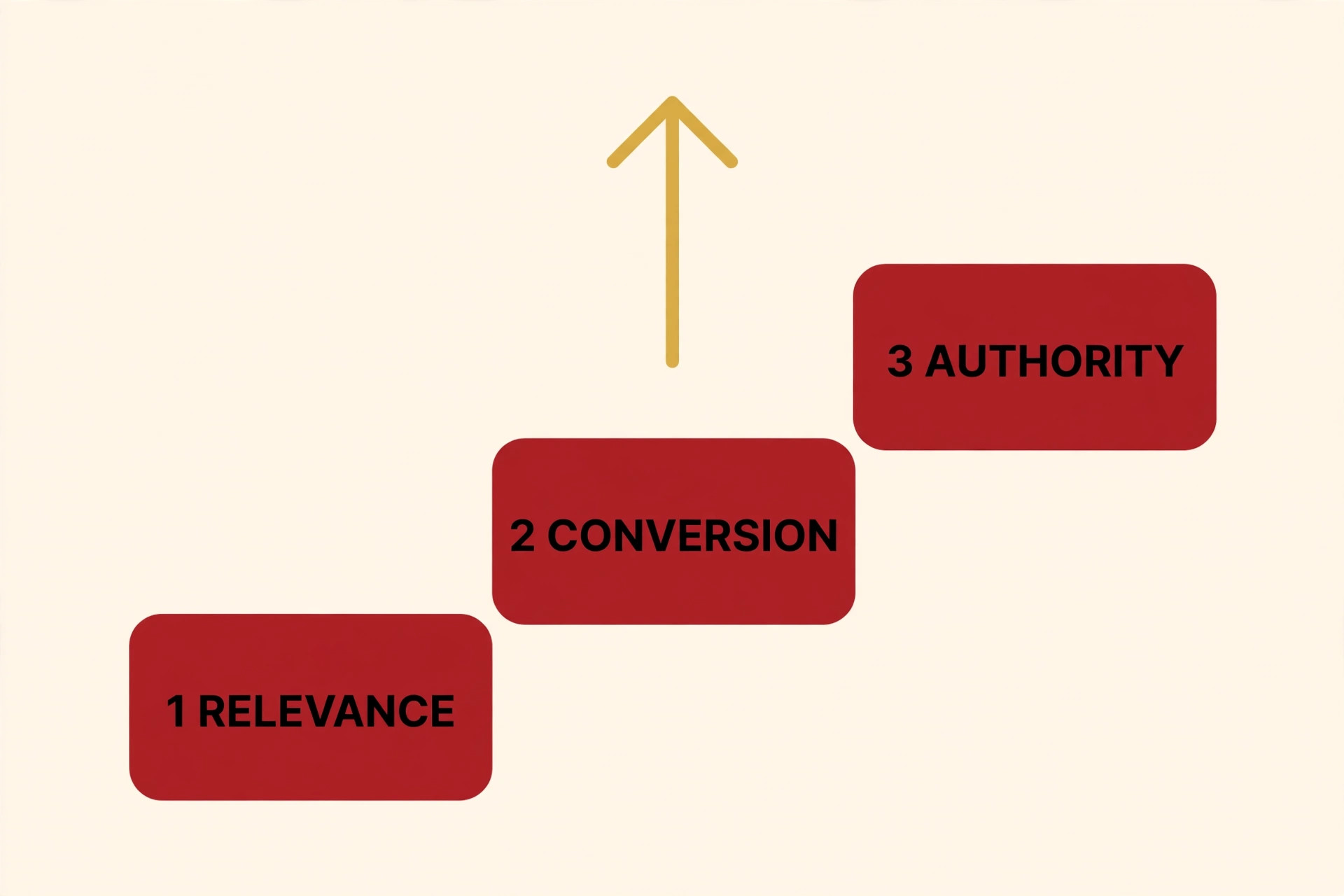
Most sellers think ranking on Amazon is a mystery — some secret the big brands know and you don’t. After designing creatives for Amazon brands for years, I can tell you it’s not a mystery. It’s a system. Amazon’s search algorithm rewards three things, in order: relevance, conversion, and authority signals. Nail all three and rankings follow. Miss one and you’ll stall no matter how hard you push the others.
Here’s the exact 3-step playbook I walk my clients through.
Step 1: Win the Click With Relevance (Keywords + Intent)
Amazon ranks products that match what the shopper actually typed. That sounds obvious, but most listings fail here in two ways.
First, they target the wrong keywords. Your title, bullets, and backend search terms need the exact phrases shoppers use — not the phrases you use to describe your product in the office. “Insulated stainless steel water bottle” is how you describe it. “Water bottle that keeps drinks cold 24 hours” is how people search. Do the keyword research before you write a single word of copy: look at what the top sellers in your niche rank for, mine Amazon’s own autocomplete, and check the search terms your ads already convert on.
Second, they ignore search intent. Every keyword carries an intent. Someone searching “dog plush toy for kids” wants to see a product that instantly reads as for kids, in the main image, in the title, in the first bullet. If your listing makes them work to figure out whether it fits, Amazon notices the hesitation — fewer clicks, fewer sales — and your rank slides.
Practical checklist for Step 1:
- One primary keyword phrase in your title, placed early, reading naturally
- Bullets written around buyer benefits, each opening with the outcome, not the feature
- Backend search terms filled with synonyms and long-tail phrases — no repeats, no filler words
- Your main image answering the search intent at thumbnail size
Step 2: Win the Sale With Conversion (Your Creative)
Here’s what most sellers miss: Amazon doesn’t just rank relevance. It ranks predicted sales. Two listings can be equally relevant, but the one that converts better climbs. That’s why your images are an SEO tool, not decoration.
When I audit a listing that “has traffic but no sales,” the problem is almost always the creative stack:
- Main image: not stopping the scroll. On a results page full of competitors, your main image has one job — get the click. Clean, bright, product large in frame, one clear differentiator visible.
- Infographics: not answering objections. Every unasked question (“will it fit?”, “is it safe?”, “how do I clean it?”) is a reason to bounce. A good infographic sequence maps one objection per image and removes it.
- A+ Content: present but generic. If your A+ modules are just your listing images resized, you’re wasting the highest-trust real estate on the page. Story, comparison charts, close-ups — this is where hesitant shoppers get convinced.
The ranking effect is mechanical: better creative → higher click-through rate and conversion rate → Amazon shows you to more shoppers → more sales velocity → higher rank. Creative isn’t step two after SEO. Creative is SEO on Amazon.
Step 3: Build Authority Signals (Reviews, Velocity, External Traffic)
The third step is the one sellers resist, because it can’t be done from Seller Central alone.
Reviews and ratings. Amazon weighs review count and rating heavily in close ranking calls. A 4.6-star product with 800 reviews will usually out-position a 4.8 with 40. Build review velocity legitimately: product inserts that ask honestly, Amazon Vine for launches, and follow-up email sequences within Amazon’s terms. Never buy reviews — one enforcement action erases everything.
Sales velocity. Rank is partly a momentum game. Launches, promotions, and well-timed ad pushes that create sustained sales (not one-day spikes) tell Amazon your product deserves the spot. This is why ranking campaigns fail when the listing in Step 2 doesn’t convert: you’re paying for traffic that doesn’t stick.
External traffic. TikTok, Instagram, and influencer traffic that converts is a ranking input Amazon actively rewards through the Amazon Attribution program and the Brand Referral Bonus. A listing with strong creative converts that external traffic far better — again, it comes back to Step 2.
The Mistake That Kills All Three Steps
Sellers treat these as separate jobs: an SEO person for keywords, a designer for images, ads for traffic. Then they wonder why nothing compounds. The playbook only works as a chain:
Keywords get you considered. Creative gets you bought. Authority signals get you kept at the top.
Skip creative and your keyword work underperforms. Skip keywords and your beautiful listing is invisible. Skip authority and a competitor with more momentum takes your spot the week you stop pushing.
Where to Start If You’re Stuck at Page 2–3
Page 2–3 usually means Step 1 is mostly right and Step 2 is leaking. Do this in order:
- Compare your main image, thumbnail-size, against the top 5 results for your main keyword. Be honest about who wins the click.
- Read your own reviews — the 3- and 4-star ones. Every repeated complaint or confusion is a missing infographic.
- Check your conversion rate in Business Reports against your category norm. Below it? It’s creative, not keywords.
- Only then spend more on ads. Ads amplify what’s already working; they don’t fix what’s broken.
If you’d rather have a designer who’s thinking about rankings while designing, that’s exactly how I work. Get in touch and I’ll audit your listing’s creative against this playbook — free.
FAQs
How long does it take to rank higher on Amazon? For an established listing with fixed creative, sellers often see movement within a few weeks of consistent sales. New products take longer — Amazon needs sales history before it trusts you with top spots. Anyone promising page 1 in 7 days is selling you something.
Do backend search terms still matter? Yes. They’re invisible to shoppers but fully indexed by Amazon. Fill all 250 bytes with relevant synonyms and long-tail phrases you couldn’t fit naturally in the visible copy.
Is A+ Content a ranking factor? Not directly — A+ itself isn’t a ranking input. But A+ improves conversion, and conversion is a ranking input. That indirect effect is why well-designed A+ listings tend to climb.
Should I run ads to rank organically? Ads are the standard way to build the sales velocity in Step 3, yes — but only once Steps 1 and 2 are solid. Sending paid traffic to a listing that doesn’t convert burns money and teaches Amazon your product doesn’t sell.